Positive reinforcement training is a dog training method that has developed over several years and is increasingly gaining ground over more traditional methods based on dominating the dog and encouraging submission and obedience through fear. Positive reinforcement training relies on key principles such as encouragement, reward, kindness, consistency, and respect. It aims to motivate the dog and encourage it to repeat good behaviors, while ignoring or redirecting bad ones. This article will examine the characteristics of positive reinforcement training, its main principles, and its limitations.
Positive dog training-what is it?
Education, whether it refers to animals or even children, has been a subject of debate for generations. In the context of dog training, it was long believed that the key was to encourage the owner to assert themselves over their animal as quickly as possible to gain power and become the dominant one in the relationship. The objective was essentially to subdue the dog and take the place of the pack leader to avoid at all costs being the subordinate. Indeed, it was long considered that the relationship between an animal and its owner was necessarily built on two opposites, namely the dominant and the submissive, and that, since the dog aspired to become dominant, it was necessary to immediately establish itself as the alpha male to avoid being overthrown.
However, for several years now, very serious studies have been conducted on the relationship between dogs and their owners, and on canine behavior. These studies have led to a different training method, based primarily on observations of domesticated dogs, rather than on wild dogs or the supposed wild heritage that our modern dogs are believed to possess. This new method, which relies on kindness, respect, gentleness, understanding, rewards, positive reinforcement, encouragement, and consistency, appears to be particularly effective.
Rather than establishing a power struggle between dog and owner, this approach fosters a relationship based on trust, cooperation, harmony, and pleasant coexistence. This training technique aims to reinforce successes, achievements, and progress rather than highlighting errors, mistakes, and weaknesses. The animal is thus encouraged and motivated to continue its efforts, not punished or humiliated for its difficulties. To achieve this, the owner reinforces good behavior and ignores bad behavior, thereby encouraging the dog to repeat its positive actions.
The animal becomes fully involved in its own training. It strives to achieve the desired reward and is thus encouraged to repeat the correct actions. Obedience is no longer achieved through fear or the threat of punishment, a method that damages the owner-dog relationship and destroys all trust. Indeed, in this case, the dog is forced to obey, which generates stress, then neurological disorders and behavioral problems, making this more violent technique a completely counterproductive method.
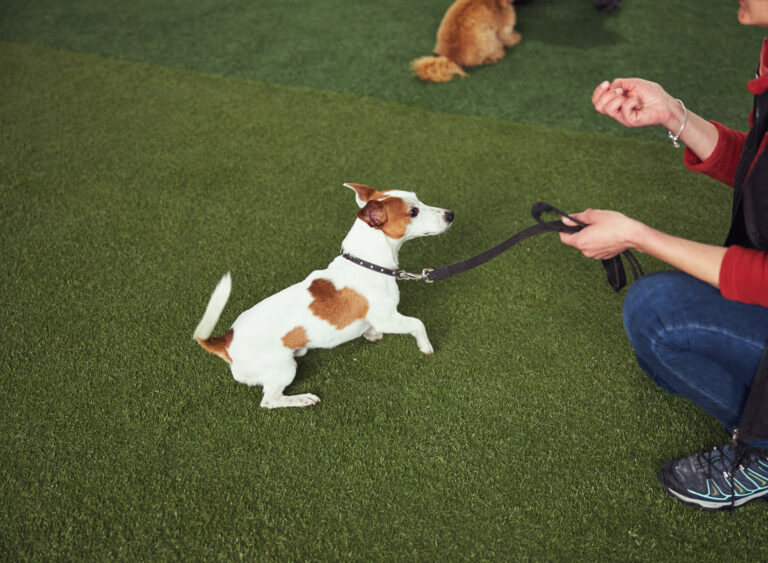
Positive reinforcement training, on the other hand, is based on the concept of reward. But this reward isn’t necessarily a treat. It can also be a pet, a favorite toy, encouraging and positive words, a play or sporting activity, or a walk together.
What are the principles of positive education?
We have already touched on them somewhat, but we feel it is important to emphasize the main principles on which positive education is based.
Promoting good deeds
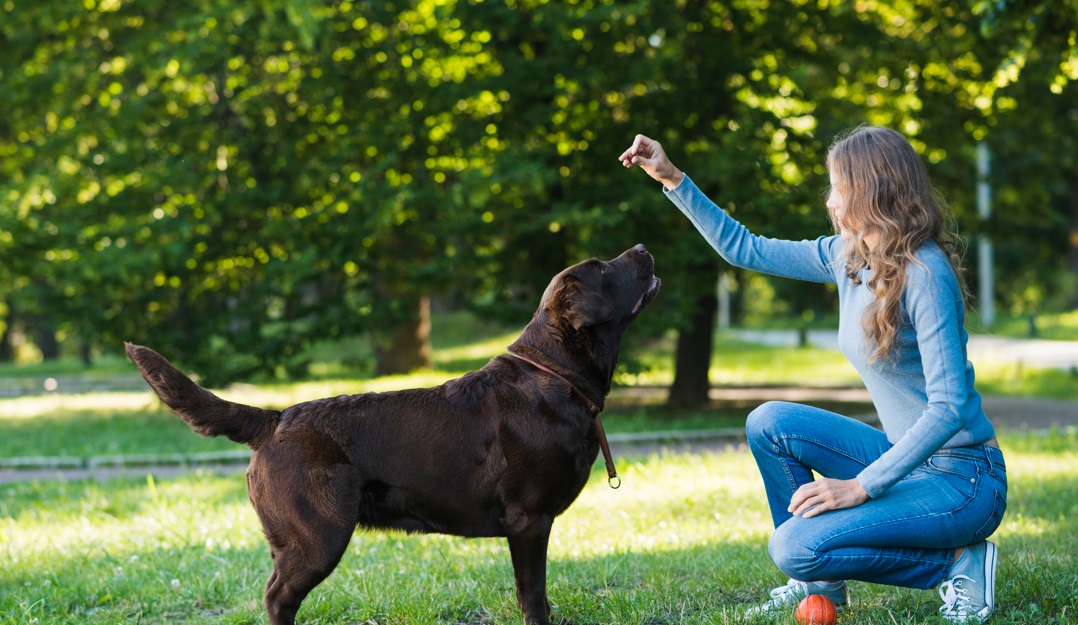
It is important to praise the animal for its successes, encourage its efforts and attempts, and reinforce good behavior. This helps it learn to repeat these good actions.
Managing bad actions
Conversely, when the dog does not act as it should, it is advisable to ignore its behavior, which usually leads to it stopping, or to redirect the negative action towards a positive replacement.
For a dog that jumps around, for example, it’s more sensible to teach it to sit.
Ignoring a behavior means completely ignoring the dog. This means not touching it, not saying “no!”, and not giving it a stern look. Ignore the animal entirely, as if it weren’t there, because its bad behavior is actually a way of getting your attention. Once it realizes it’s no longer getting the attention it wants, it will naturally stop its bad behavior. This is the principle of extinction.
Motivating through reward
It is essential to reward the animal for its successes and to use the reward as a motivator to guide the dog towards the desired behavior. This motivation can take many forms, as it doesn’t necessarily mean constantly feeding the dog treats. It could be a favorite toy, a play session, petting, encouraging and positive words, a walk, and so on.
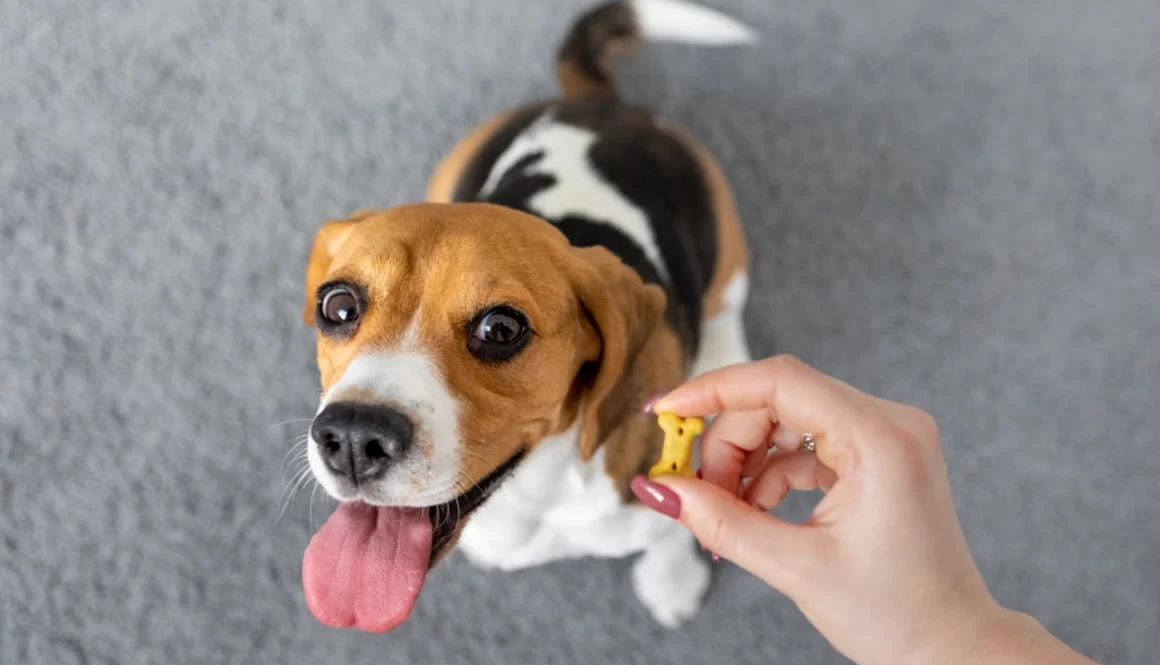
Of course, for success to be achieved, the reward must be commensurate with the effort and the dog’s preferences. Treats generally work very well, it’s true, but this isn’t always the case. In any event, the goal isn’t to overfeed the animal, but to give it a small treat to reward success. With short training sessions, the dog isn’t overfed, and once a behavior is well learned, the treat can gradually be replaced by a pat, positive reinforcement, etc.
Remember that a dog will always be rewarded for getting what it wants. Sometimes, all it desires is to see the door open so it can go outside to play or go for a walk. Encouraging good behavior can be as simple as thening the door to the garden or outdoors. In this case, there’s no need for treats or petting; the dog will cooperate and perform the desired action to get what it wants.
Conversely, avoid rewards that aren’t suitable for your furry friend. If he doesn’t tolerate contact and petting well, for example, don’t reward him by stroking his head, as he’ll experience it negatively and won’t try to repeat the good behavior. To avoid being touched, he’ll instead try to avoid repeating the behavior. So, pay attention to your dog’s needs and focus on the most effective reward.
Building a relationship of trust
Your dog needs to be able to rely on you, trust you, and feel safe by your side. To achieve this, violence, punishment, bullying, and humiliation have no place. You must encourage your dog’s successes, support and respect him, but also ignore or redirect his behavior. Once a dog obeys out of fear, he no longer trusts you and only pleases you to avoid feeling threatened.
Demonstrate firmness
Positive training should not be confused with permissive training. Positive training is based on kindness and respect, but it must also include firmness. It’s not about letting the animal do as it pleases, but rather about establishing a framework and boundaries in its learning, elements that will help to reassure it.
Always be consistent
This is one of the foundations of positive reinforcement training. For your pet to learn alongside you, you must be consistent. This involves providing them with:
- Short, clear, and easy-to-understand commands, which will be easier for him and for you to remember (“sit!”, “lie down!”, “stay!”, “heel!”, etc.);
- always use the same terms for the same command, because if you change the word to say something, your animal will be confused and will not understand what it has to do;
- always pronounced in the same way, because the dog is sensitive to your tone of voice;
- always accompanied by an appropriate facial expression, because the animal is very sensitive to it.
Positive dog training-what are the limits?
While positive education has many advantages, it is not without its drawbacks.
It’s important not to confuse positive reinforcement training with excessive permissiveness. As we’ve said, dogs need structure and boundaries, and establishing rules is essential. Therefore, you mustn’t go to the other extreme of never saying “no” or letting the animal do whatever it wants.
To ensure harmonious cohabitation within the home, you must not leave your dog without rules or boundaries. He needs structure to develop and grow positively.
The owner must be a guide for the animal, a reference point who provides security, teaches, and controls the dog to help it acquire good behavior and a healthy balance.