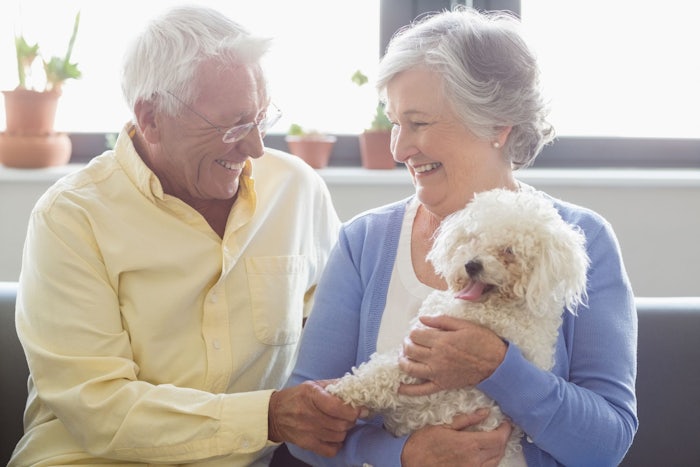
Moving into a nursing home is undeniably a difficult step for an elderly person. In addition to the loss of a familiar environment, a circle of friends, and independence, there is often another painful experience: parting with a pet. A cat, a dog, birds… companions, sometimes elderly themselves, who provide comfort, companionship, and even a reason to live for an older person. Until now, pets were rarely allowed in nursing homes, but the law has changed: now, pets are welcome with their owners in nursing homes. Under certain conditions.
Entering a nursing home with your pet a right now recognized by law
For a long time, the presence of pets in nursing homes was left to the discretion of each facility, often governed by restrictive internal regulations. Many simply prohibited them. This forced separation led to painful situations for both the resident and the animal, and, in some cases, to abandonment.
A law recognized as a major step forward
build the society of healthy aging and autonomy”, introduced into the Social Action and Families Code (CASF), the right for residents of nursing homes and independent living residences to keep their pets.
Specifically, the law specifies: “The resident of a care home for dependent elderly people or of an independent living residence has the right to receive or keep their pet, except in the case of proven dangerousness of the latter and subject to the agreement of the managing legal entity, which cannot oppose a refusal in principle”.
A decree to specify details
Finally, the decree of March 3, 2025, detailed the hygiene and safety conditions, as well as the obligations incumbent upon the resident and the establishment. This decree does not impose restrictive criteria regarding species, size, or weight for the majority of domestic animals, contrary to what had sometimes been considered.
The only exception that could lead to a refusal is if the animal is dangerous.
Conditions for allowing a pet in a nursing home
The law exists, and that’s a good thing! However, it requires strict regulation for the well-being of the animal, the safety of other residents and staff, and compliance with health regulations.
Veterinary and sanitary requirements
Logically enough, to be admitted to a nursing home, an animal must have a complete veterinary file attesting to its good health and compliance. The file must include:
- Its identification, since the cat, dog, or ferret must be identified by an electronic chip or tattoo;
- Its vaccination record must be up to date. All recommended or mandatory vaccinations must be current. For dogs, vaccination against rabies ( if necessary), distemper, infectious canine hepatitis, parvovirus, and leptospirosis is often required. For cats, vaccinations against feline panleukopenia (feline distemper), feline viral rhinotracheitis (feline herpesvirus), and feline leukemia are essential.
- Evidence of internal and external parasite treatment ;
- A certificate of non-dangerousness issued by a veterinarian must attest to the absence of potentially dangerous or aggressive behavior. The animal must also be able to live in a group environment;
- Sterilization or castration. Admittedly, it is not mandatory, but it is recommended, especially for cats.
The resident’s ability to meet the animal’s needs
The right to keep a pet is linked to the resident’s ability to provide for its needs. This can sometimes be problematic… The nursing home is responsible for assessing this autonomy, based on several criteria:
- Daily care: feeding, brushing, changing bedding, petting…;
- Dg walking: Daily dog walking is a major constraint. If the resident is unable to do it themselves, the law requires them to arrange an alternative solution, which can be provided by a family member who commits to coming regularly, a volunteer from a local association, or a paid service provider. In any case, this solution must be formalized.
- Financial responsibility: all costs related to the animal remain the responsibility of the resident or their family.
Compliance with the internal regulations of the nursing home
In practical terms, the law grants the right to have a pet in a nursing home, but the facility’s internal regulations determine the specific arrangements. Thus, a nursing home may establish precise rules regarding:
- The permitted and prohibited areas where the animal can move around. In general, bedrooms and outdoor areas are permitted, the dining room, kitchen, infirmary ary… are prohibited, mainly for hygiene reasons.
- Relations with other residents: the animal must not cause any nuisance or disturb the peace of the establishment.
- The management of excrement must be ensured by the resident or one of their relatives.
Categorical exclusions
The law is strict regarding potentially dangerous animals. Category 1 and 2 dogs, known as attack or defense dogs, such as pit bulls or rottweilers, even when muzzled, are formally excluded from admission to nursing homes.
What should I do if they refuse?
If the nursing home refuses to accept the animal, the decision must be justified and discussed in particular within the Social Life Council (CVS), where residents, families a, nd staff are represented.
The benefits of the psychological health of the elderly
Numerous psychological studies demonstrate that living with an animal is a powerful factor in psychological well-being, especially if the bond between owner and animal is long-standing. An animal is a life companion that carries within it the resident’s entire history and memories. It can facilitate an elderly person’s entry into a care facility in several ways:
- Reduction of anxiety, stress, and isolation for the elderly person who, overnight, changes their environment and lifestyle;
- Maintaining cognitive ability: a cat or dog has a routine, and it keeps its owner in reality.
- Communication tool: Upon entering a nursing home, an elderly person must make a greater effort to approach other residents and get to know them. The same applies to the staff. Their pet will help them communicate.
- A sense of purpose. By keeping their pet close and caring for it, an elderly person will continue to feel useful. It’s a way to give meaning to their life, in a place where this notion is often undermined by the loss of independence.